 Client portal


 News
News
A shift to focus on productivity as AI and investment opportunities emerge
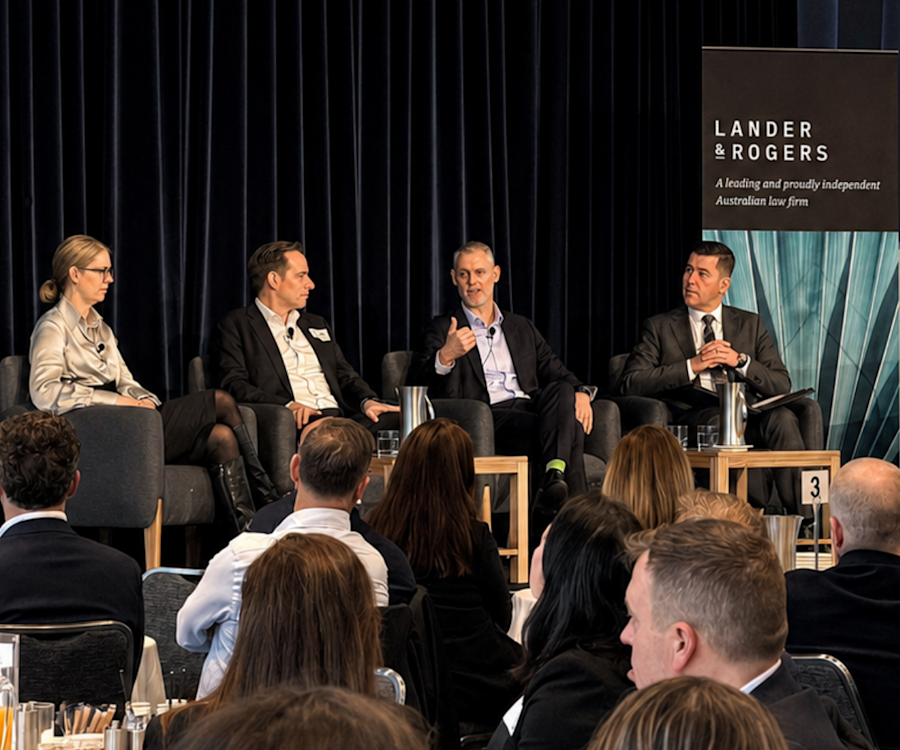
More than 250 clients, colleagues and guests joined Lander & Rogers' 2026 Melbourne Economic Briefing on 20 August to hear leading economists, business leaders and investors discuss the forces reshaping the Australian economy and what they mean for businesses over the coming decade.
Keynote speaker, Commonwealth Bank Chief Economist Luke Yeaman, said businesses were operating in a fundamentally different environment to the one that shaped much of the past decade, with volatility, disruption and uncertainty increasingly becoming permanent features of the global economy.
He identified four major forces reshaping the business landscape and influencing economic growth, investment and productivity:
- Shifts in the geopolitical environment, with the US/Iran conflict and changing power dynamics between the US and China driving a push towards derisking supply chains, and bolstering national resilience and defence
- A new tech revolution spurred by the rapid investment and adoption of AI and other emerging technologies, with governments and the private sector weighing up the risks and benefits and likely impact on industry and productivity
- The net zero transition and its resulting challenges to energy security and the electricity and gas markets
- Changing demographics, with ageing populations, declining birth rates and population decline causing knock-on effects for economic growth.
Against that backdrop, he said there were clear signs the Australian economy was slowing following a succession of interest rate rises, the Federal Government's recent tax reforms and the impact of the Iran conflict on confidence. Commonwealth Bank data indicated that weaker consumer and housing demand would continue to weigh on growth through the second half of 2026, while core inflation was expected to trend back towards target by mid-2027. While this could create scope for one or two interest rate cuts, he noted the Reserve Bank was likely to remain cautious given ongoing uncertainty around oil prices and tensions in the Middle East.
The keynote was followed by a panel discussion led by Lander & Rogers partner John Wells, featuring Productivity Commission Chair, Danielle Wood, CapitaLand Investment Australia CEO, Angelo Scasserra and Commonwealth Bank Chief Economist, Luke Yeaman.
While panellists acknowledged the uncertain global backdrop, discussion quickly turned to what many viewed as Australia's most pressing long-term challenge: productivity.
Panellists agreed that Australia has struggled to achieve meaningful productivity growth in recent years, with the consequences increasingly being felt across the economy through slower growth, rising costs and growing pressure on living standards.
Artificial intelligence was identified as one of the most significant opportunities available to Australian businesses to help address the productivity challenge. While the full economic impact of AI remains uncertain and may take several years to materialise, discussion focused on the importance of organisations beginning the work now, rather than waiting for definitive proof of the benefits — a particular challenge (and opportunity) for small and medium sized businesses. Businesses that successfully integrate AI into everyday operations and re-think the way work is performed are expected to be best placed to capture future productivity gains. The discussion reflected broader expectations that AI could deliver a meaningful lift in productivity over time.
Panellists also observed that Australia remains a highly attractive destination for foreign investment. Significant pools of global capital are available and investors continue to view Australia as a stable and desirable market. However, unlocking that investment remains a challenge.
Red tape, planning delays, labour shortages, infrastructure constraints and rising construction costs were identified as ongoing barriers to bringing projects to market. Panellists noted that attracting greater investment would require ambitious reform to address structural barriers that are limiting economic growth.
The overarching message for business leaders was clear: while economic and geopolitical uncertainty are likely to remain a feature of the operating environment, organisations that embrace innovation, invest in productivity-enhancing technology and position themselves to take advantage of emerging investment opportunities will be best placed to succeed in the years ahead.
The Lander & Rogers Economic Briefing is an annual event for Australia's legal and business community. We bring together senior economists and leading business experts to share their perspectives on the short- to medium-term economic and business outlook, and the risks and opportunities in today's economic climate. For more information and to attend future briefings in Melbourne and Sydney, contact [email protected]
Key contacts




Share


